Invite colleagues to your team and give each of them the level of access they need. redirect.pizza has four roles, and on the Business plan and up you can further scope what a user sees with tags.
Manage users under More, Users. Invited users receive an email with a link to set up their account. Additional team members are available from the Pro plan and up.
Roles
Owner
The owner manages the team. This role has every permission, including billing, team settings, API tokens, automatic DNS, the firewall, SAML SSO, the activity log and inviting or removing users. A team always has at least one owner. Owners can change the role of any user, including promoting a member to owner.
Member
A member does the day-to-day work. Members can:
- Create, edit, view, import and export redirects
- Create, edit and view email forwards
- View and edit hostnames
- View analytics
- Manage tags
Members can't manage billing, API tokens, automatic DNS or the firewall, change team settings (such as the team name and default security settings), view the activity log, invite or remove users, or delete the team.
Read-only
A read-only user can view redirects, email forwards, hostnames and analytics, but can't change anything. Use this role to share insights with stakeholders without the risk of accidental changes.
Billing
A billing user only has access to the Billing tab: updating payment details, changing the plan and downloading receipts. This role is meant for your finance department and can't see or change redirects.
Access control with tags
Available from the Business plan and up.
By default, members and read-only users see every redirect in the team. If you organize your redirects with tags, you can restrict a user to specific tags, or exclude specific tags. Redirects, hostnames, email forwards and analytics are then scoped accordingly. The same mechanism is available for API tokens.
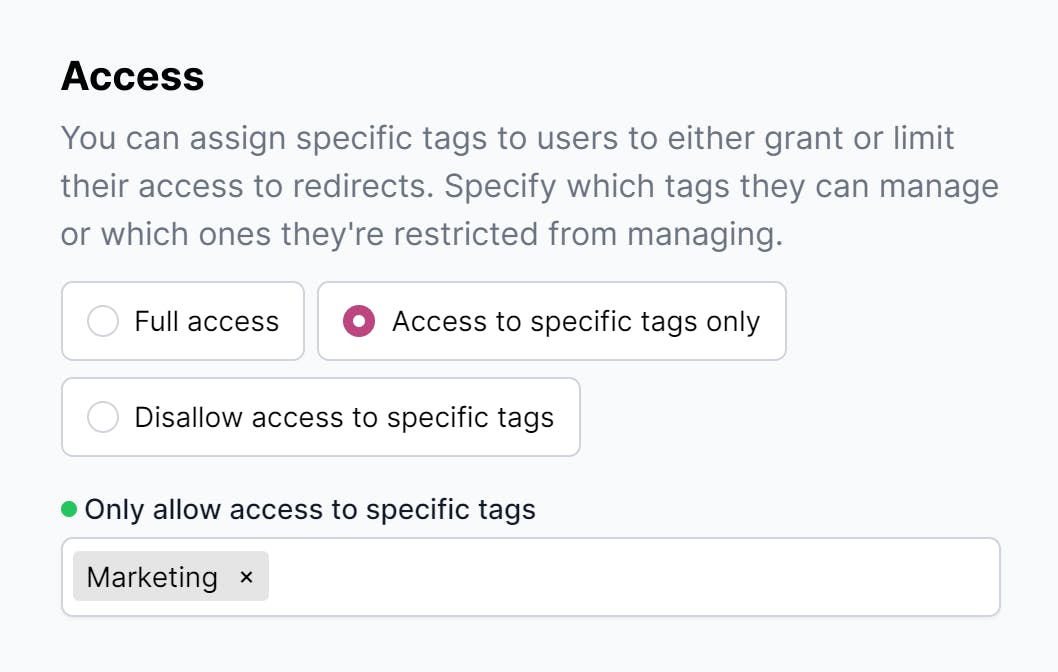
Example 1: a dedicated environment for marketing
Tag every marketing redirect with Marketing. Then give each marketing team member access to the Marketing tag only. They see and manage exactly the redirects that are relevant to them, and nothing else.
Example 2: broad access with one exception
Tag the redirects that should stay private with Restricted, and exclude that tag for the users concerned. They keep access to everything else, while the restricted redirects are only visible to owners and to users who are explicitly allowed.